Search Engine Optimization (SEO) has changed dramatically since its inception. Initially, SEO was fueled solely by keyword insertion and backlinks. However, today SEO is fueled by cutting-edge technologies like Natural Language Processing (NLP), semantic comprehension, and AI-based algorithms. Google, Bing, and other search engines have become smarter by the day, making it vital to comprehend these changes if one wants to succeed digitally.
In this article, we discuss the most important differences between modern and traditional SEO, delve deep into innovative topics such as LLMO, RAG, GEO, and point out what the future of search optimization is all about.
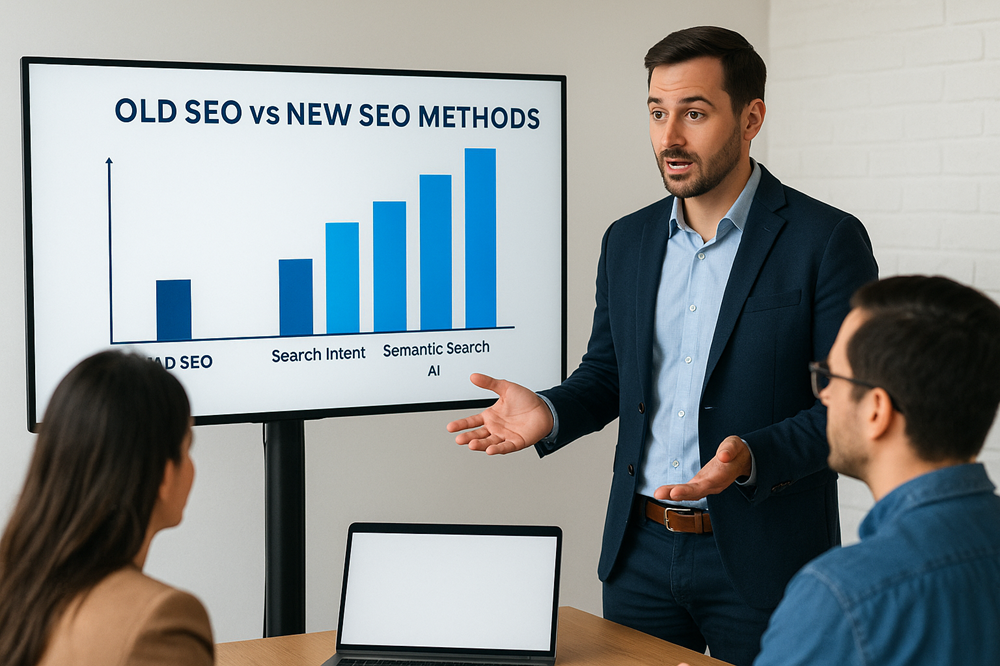
Then vs Now: How SEO Has Evolved
| Old SEO (2000s–2023) | Modern SEO (2024–Present) |
|---|---|
| Focused on keyword density | Focuses on user intent and context |
| Manual backlinks and directories | E-A-T (Expertise, Authoritativeness, Trustworthiness) |
| Meta tag stuffing | Semantic search and NLP-driven context |
| Basic on-page HTML signals | Schema markup, structured data, and rich snippets |
| Desktop-first optimization | Mobile-first and voice-first indexing |
2. LLMO (Large Language Model Optimization)
LLMO represents a new horizon in SEO, where content is written with the intent to optimize for the comprehension and retrieval of data by large language models (such as ChatGPT, Google Gemini, and others). These models are emerging as a new layer between users and websites—facilitating discovery through summaries, direct answers, and conversational interfaces.
Some of the primary considerations for LLMO-optimized SEO:
Prioritize clarity, structured information, and factual accuracy.
Write content that is simple for AI to summarize or extract answers from.
Utilize plain headings, bullet points, and question-and-answer structure.
- RAG (Retrieval-Augmented Generation)
RAG is a type of AI system that pairs classical retrieval (pulling in documents) with generative AI (such as LLMs). For SEO, it implies AI can pull in appropriate content from your site in real time to respond to sophisticated user queries.
Why it matters for SEO:
Your content should be extremely relevant, fresh, and accessible.
Content has to be indexed in a manner which enables easy context extraction by AI.
Internal linking and topic clustering become all the more important.
- GEO (Generative Engine Optimization)
GEO is SEO for AI response-generating engines (e.g., Google’s AI Overviews, Bing Copilot, ChatGPT Browsing). You don’t want to rank on a search results page in traditional SEO but want your content cited in the AI output.
Best GEO practices:
Publish authoritative, fact-filled, and well-organized content.
Utilize schema markup and reference credible sources.
Track brand mentions and citations online.
- Entity-Based SEO
Search engines presently comprehend entities (people, places, brands, concepts) and their interconnections. Instead of keyword matching, engines currently match meaning.
How to utilize entity SEO:
Utilize schema to clearly define entities.
Create topic clusters to reinforce key entity themes.
Earn citations from other credible sources to enhance your brand entity.
- Semantic Search & NLP
Semantic search and NLP have substituted literal keyword matching with understanding based on intent. NLP allows search engines to understand synonyms, sentence order, and even tone.
SEO implications:
Pay attention to answering questions posed by the user directly.
Utilize natural language, not stiff keyword repetition.
Compose content that reads and sounds like a human conversation.
- Schema Markup & Structured Data
Schema markup helps search engines understand content better and deliver rich results—like FAQs, ratings, product prices, and more.
Benefits:
Increases visibility with enhanced snippets.
Enables features in voice search and AI summaries.
Essential for LLMO and GEO readiness.
- Topical Authority
Being an expert on one topic is better than writing shallow content on many topics. Search engines now prioritize depth over breadth.
To build topical authority:
Create comprehensive guides around your niche.
Interlink relevant posts to create a knowledge base.
Regularly update content with fresh insights and information.
- Trust Signals
Search engines consider trustworthiness to be a fundamental ranking factor, especially for YMYL (Your Money, Your Life) content.
Main trust indicators:
Author bios with credentials.
Secure website (HTTPS).
Verified customer reviews and testimonials.
Clear privacy policy and contact information.
- Voice and AI Search
With the advent of smart assistants and AI chatbots, more are searching by voice or conversation instead of typing.
To ready yourself for voice/AI search:
Employ conversational terms and long-tail phrases.
Organize content in Q&A patterns.
Optimize for featured snippets and zero-click responses.
The Future of SEO
SEO is going multimodal optimized not only for search engines, but for AI agents, voice interfaces, and generative assistants. The future holds:
Conversational interfaces becoming the replacement for traditional search.
AI-powered content curation for customized experiences.
User behavior- and AI-informed real-time optimization.
To remain competitive, marketers need to blend technical SEO, content greatness, and AI knowledge.
Conclusion
SEO is no longer about keywords alone it’s now about context, intelligence, and meaning. Technologies such as LLMO, RAG, and GEO are creating a new paradigm in which your content needs to be optimized for humans and machines. As search continues to evolve, being knowledgeable and agile will be the ultimate competitive edge.